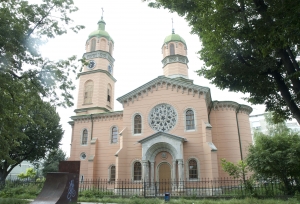
11111About the Armenian Church in Roman an old tradition says that the first wooden church was bought from Transylvanian Saxons in 1335. But, because this one was either ruined or no longer met the requirements of a growing population, the construction of a new spacious stone church was needed. Therefore, the present church was built in 1558 – 1609, on the same place of the wooden church, by the Armenian nobleman Agópsha, in the memory of his whole family. The original votive inscription was preserved, being translated by bishop Melchisedec Ștefănescu: “Through God’s grace, commiseration and will and by the divine choice and for the glory of His Only Begotten, in this difficult times, God chose a fair man called Agopșa, to build this church in the name of the Mother of God, in the memory of his name and of his wife Mughala and of his parents Mr. Vastan and Mrs. Dolvath and of his sons Vastan, Saco… and Donig and of his daughters Melusha and Dolvath, in the Armenian year 1058 (1609), September. Father Khaciadur.”
11111In 1642, with the occasion of a journey in Moldavia, Petru Bogdan Bacsev, the first catholic bishop in Sophia, also visited Roman and stated that: “The Armenians have 80 houses and 450 inhabitants. They have not an ugly stone church which is painted and a priest from their Armenian race…”
11111In the 19th century, near the church were added the bell tower, some annexes and decorations. The construction, on a cross-shaped plan, with rectangular lateral apsides and semicircular altar apsis has 19 windows and two steeples with stone carved borders. All this elements give elegance and slenderness to the entire edifice.
11111In 1830 – 1831 the church was renewed. This fact is also mentioned on the church iconostasis. Another inscription on the northern wall informs us that the present edifice is the result of more recent works, executed between 1863 and 1868 under the guidance of the Bavarian architect Johan Brandel de Daggendorf. In that period the church was expanded and renewed based on a neoclassical project, at the initiative of two richer parishioners (Donica Simionovici, owner of Simionești – Cordun – domain and Teodor Solomon which had a domain at Butnăreşti-Roman). During this works the church was heightened, the porch and the bell tower were built – a horologe made in Austria was installed – giving the church a similar appearance with the Armenian church in Iași.
11111Probably in the same period was also realised, with the Pantocrator and The four Evangelists from the base of the main steeple, the painting of the iconostasis and the painting of the icons from the nave and narthex walls, which reflect the influence of Armenian art. The oldest icon of the church, whose origins are known, dates from 1797, but it also exist undated icons that can be much older. The wall painting from the nave was sponsored by baron Christe Kapri in 1905.
11111The way it looks today, the Armenian church in Roman is a monumental edifice that strikes with its special aspect of the facades and dominates with authority the surrounding area. It has a cruciform design with rectangular lateral apsides and a semicircular apsis of the altar, massive base of carved stone and the exterior surface with horizontal layers. Stone rosettes which decorate the lateral apsides, the framework of the 19 windows and the molded cornice with elongated dentils give beauty to the construction. The two steeples (above the nave and porch) with their stone carved borders give an elegant and slender appearance to the entire edifice.
11111The interior is also decorated with profiles and stone sculptures which suggest the oriental art through their motifs of Armenian, Persian or Arabian inspiration and the sensation of monumentality is entrenched by the amplitude of the domes supported on the same oblique arches which characterize Moldavian churches.
11111During the communist period the church was closed and was falling into ruin as an outcome of the drastic diminishing of the local Armenian colony and henceforth, in March 1981, was entrusted to the Orthodox bishopric of Roman… for temporary use, on an indefinite period of time. Based on this agreement, extensive restoration, consolidation and development work was made. The iconostasis was brought forward to ensure necessary space for the altar and to comply with the requirements of the orthodox service.